Thursday, December 4, 2008

Shall I Compare Thee to a Saxophone?

An abbreviated version of this article appears in the December issue of the Cal Shakes e-newsletter. Click here to subscribe to the newsletter.

Back in August of this year, New Works/New Communities program director Jessica Richards sat down with Cal Shakes Associate Artist Andy Murray to chat about his Write 2 Read Community Residency, part of the Alameda County Youth Literacy program at the Juvenile Justice Center. The resulting article ran in our Uncle Vanya program, and since then, Murray has continued to visit the kids in the center's classrooms.

When the actor and teacher began his latest visits in late November, he was about to open The Seafarer at Marin Theatre Company, a play wherein Murray’s character ends up playing a card game with the devil for his soul (and which has been extended through December 14). Though he says it’s really hard to find a parallel in your life for something like that, “in all great works of dramatic literature, you find parallels. Like in Macbeth, there’s very few people who are going to end up killing the King of Scotland. But there’s plenty of people who have been faced with a moral choice because they wanted something, whether it’s a candy bar in the store or their best friend’s girlfriend, they’ve said, ‘I know this is wrong, but I’m gonna do it anyway.’”

Getting the kids in the three Write 2 Read units to relate to literature is one of Murray’s primary challenges, along with the changeable nature of the classroom population—kids being late or absent, leaving or entering the center—and getting the students to just settle down. “But you do what you can, introducing them to a few famous speeches and getting them to speak the language out loud and talk a little bit about what it means and how it might relate in some way to their experience, everyone’s experience.” So he brings in speeches from the four major tragedies—Macbeth, King Lear, Othello, and Hamlet—and also some sonnets. Some units want him to read the text aloud before they take a crack at it, because it helps them understand. “I always say, ‘well, you read it. You read it.’ And I’ve always said ‘no.’ I know how to read it. But it actually really helps them to understand it if I read it first, and then we can go through it. I hadn’t figured that out. I’d always been about throwing the attention off me and putting it on them, but it’s actually really helpful to do it this way. So that’s something that I learned this time, and it’s always about learning what works better.”

In a coed unit, Murray brought in Sonnet 18, the one that famously begins “Shall I compare thee to a summer’s day? Thou art more lovely and more temperate.” Then, he asked them to rewrite the opening lines.

“I tell them that a summer’s day in England is no small thing, since it’s always raining. It’s like, ‘shall I compare you to one of the greatest days of the year?’ So I say to them, ‘what do you like, what do you find beautiful?’ And it’s a push to get them doing it, but one girl said, ‘Shall I compare you to a saxophone? You’re better because you can’t get any dents and I don’t need WD-40.’ I said to them, ‘I read a lot of poetry, and in the thousands, hundreds of thousands of poems written since Shakespeare first wrote a poem, that may be the first one with the reference to WD-40.’ So that’s a great thing. It’s hard to get them to push their imaginations a little further. Most of them want to talk about money, drugs, sex, you know? Some teachers are OK with that, but I always want to get them out of that place. They spend their whole lives talking about money, drugs, and sex, which is partially a function of being a teenager. But with these guys, it’s really hard to get them away from those stock references they have in their lives. But I want to get them to use their imaginations, and see alternative ways of expressing themselves. So that’s the challenge.”

Wednesday, December 3, 2008

2009 Season Designer Profile: Romeo and Juliet's Andre Pleuss

In the months leading up to our 2009 Main Stage season, we’ll be profiling the creative minds behind the season’s productions—Romeo and Juliet, Private Lives, Happy Days, and A Midsummer Night’s Dream—in our e-newsletters. For the inaugural installment, we are introducing newsletter subscribers to sound artist Andre Pleuss, an Artistic Associate at Lookingglass Theatre (Chicago) who designed sound for our 2008 production of Twelfth Night, as well as Berkeley Rep’s current production of Arabian Nights. What follows is the full transcript of my email interview with Mr. Pleuss. To sign up for our email newsletter, click here.

If you could have composed music and/or designed sound for any production(s)—historical or modern—what would it be?
I would love to have composed/designed JoAnne Akalaitis' production of Iphigenia, Tina Landau's Space, and most things I've ever seen produced by SITI Company and recently Elevator Repair Service. I love the Greeks and I always want to design any House of Atreus plays (or adaptations) that come along. I'd also love to write/design for the Japanese multi-media theatre-arts/dance collective Dumb Type. They blow my mind.

Who are your favorite composers (theatrical and nontheatrical)?
My favorite theatrical composer these days is ... hmm that's tough. I guess I'd say Richard Woodbury in Chicago, and Willy Shwarz in Germany. I also like Michael Keck's music a lot, and Victor Zupanc in Minneapolis I think does great work. I loved the music for Les Waters' production of To the Lighthouse at Berkeley Rep a few seasons back, written by Paul Drescher.

My favorite nontheatrical composer is Frank Zappa (unrivaled prolific genius IMHO). I'm a big fan also of Jon Brion (as both a composer and producer). His music for Punch Drunk Love is always on heavy rotation on my iPod. I'd also add Rufus Wainwright to that list.
What's your favorite band? Or bands?
I'm going through a huge roots music phase right now. (I can't stop listening to the Alison Krauss/Robert Plant album Raising Sand. Gillian Welch, Jolie Holland and the Be Good Tanyas are also in heavy iPod rotation these days.) Unrelated, I find Postal Service endlessly fascinating—not just musically, but in terms of their process (i.e., rarely being in the same room, but rather sharing files across the country via the internet, passing them back and forth layering tracks gradually over time).

Oh yeah, and I'm a sound designer so it's like a prerequisite to be a Radiohead fan. And I am, proudly.

You recently did Romeo and Juliet at Shakespeare Santa Cruz; I know it's a bit early to be thinking too much about our upcoming production, but can you provide any insight at all into how that production, with its Hungarian Gypsy feel, may inform how you approach the Cal Shakes '09 one?
I wish I could. It's still quite early and Jon and I have only had one conversation. I will say that it is great having the play still very resonant in my mind. I don't think I've ever worked on the same play (with different production aesthetics, et cetera) so closely on top of one another before. I'm really thrilled that it's this play. I've always thought I could work on Romeo and Juliet once every few years for the rest of my career and not be bored. There is so much going on in that world emotionally, dramatically. It's sexy, romantic, violent and lyrical, joyous and profoundly sad all in the same breath. If any one play can kick-start a designer's imagination in a wide variety of different directions, it's this one.

Tuesday, December 2, 2008

Art(s and Crafts)istic Learning

Our Artistic Learning residency programs are everywhere. Click on the arts and crafts project photo below for a good look.

Thursday, November 20, 2008

Main Stage 2008 polls-a-poppin'—what's your favorite??

OK, so, don't try to deny it: We're halfway through November already. Some people have finished shopping for holiday gifts, while the rest of us are just starting to feel the guilt of not having started. (Or, if you're like me, you're thanking your lucky, lazy stars that you never got around to mailing those birthday presents to the east coast.)


Here at Cal Shakes, we've just finished general auditions for the 2009 season. Our esteemed graphic designer has already designed a number of attractive choices for Romeo & Juliet art, and will be working in earnest tomorrow on the show art for Private Lives. Our Spring Classes brochure will go to the printer in the next few weeks, and, perhaps most importantly, I think I saw the receptionist Administrative Project Manager preparing the bowl full of Secret Santa name choices yesterday.

But the 2008 season still looms large over all of this next-season preparation and year-end festivity: The Development department is preparing "Return on Investment" reports for all of our sponsors, filled with impressive numbers and beautiful pictures from the most reason Main Stage productions; and, in fact, this time of year we're constantly reviewing the photos from all of our 2008 activities—Main Stage plays and Audience Enrichment events, Summer Theater Programs, adult classes, New Works/New Communities workshops, and more—for use in various brochures, web pages, and other marketing materials.

As a result, I find myself in my usual state of mind for this year—much like that phenomenon wherein you can't discern which childhood memories are legitimately yours, or which have been created by looking at photo albums and home movies, I'm currently so overwhelmed and impressed by the visuals generated by Kevin Berne and Jay Yamada this season that I can't recall which 2008 Cal Shakes productions and individual performances were my favorites.

Can you? I'm curious as to what Main Stage stuff that folks who read this blog liked best in 2008—not just overall productions but also individual performances, costumes, set and lighting design, even specific moments from Pericles, An Ideal Husband, Uncle Vanya, and Twelfth Night. If you've got opinions, please express them in the comments section!


Pictured, from top to bottom: Delia MacDougall and Sarah Nealis in Pericles, as photographed by Kevin Berne; Michael Butler in An Ideal Husband, as photographed by Kevin Berne; Barbara Oliver and Annie Purcell in Uncle Vanya, as photographed by Jay Yamada; Andy Murray and Dan Hiuatt in Twelfth Night, as photographed by Jay Yamada.

Tuesday, November 18, 2008

Cal Shakes' European Vacation (OK, so it's really our Costume Director's trip to a costuming symposium, but ...)

The following was written by Cal Shakes Costume Director Naomi Arnst.

In May of 2007, at a Costume Society of America Symposium, Susan No
rth of the Victoria and Albert Museum announced that, at the the Costume Colloquium in November of this year, several institutions were planning a tribute to Janet Arnold, on the tenth anniversary of her death. Arnold was one of the premier dress historians of our time (her book Patterns of Fashion Vol. 3 is at right), and my hero, so, as soon as I returned home, I checked my mileage plan; I was really close to a European reward, so the plan was set.

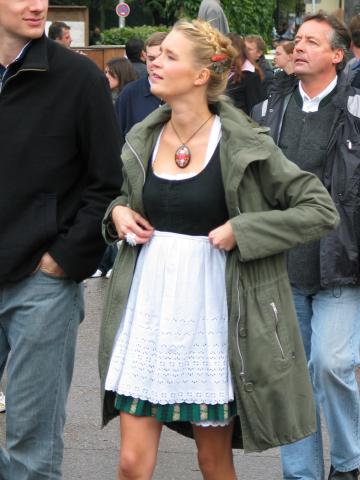
As it turned out, however, I had to fly free to Munich first. This was the first time I had ever been to Germany and, being half German, I was right at home. It was like returning to my childhoodthe food, the language, the musicall brought me back. One of my favorite things, of course, was the Bavarian embrace of the ethnic dressit just made me giddy. Since I used to be a muumuu designer in Honolulu, it's great to see other cultures wherein ethnic dress has become widely adopted kitsch (see photo to the right). While in Bavaria, I climbed to the Neuschwanstein Castle to see how King Ludwig II lived, and the next day did a Sound of Music foot tour of Salzburg, Austria. Salzburg was fabulous, and the locals really do wear the Tyrolean garb as day wear. The Old City takes your mind back to Mozart's time, and earlier. Then again, my mind is known to time travel.

Soon it was on to the main event: The Costume Colloquium in Florence, Italy. A nine-hour train ride later, I was there (I think I'm done with sleeper cars after this trip). The weather was fabulous the whole time in Florence; if I wasn't in a symposium session I was walking my feet off for six days straight.


The Costume Colloquium focused on several aspects of the field of History of Dress.

First, on the status of academic programs in the UK, Italy, Switzerland, and some in the US. There are more programs in Dress, Archeology, Restoration, and Costume than ever before, but to keep funding is a real battle in these strained economic times. As a result, many programs are moving toward an artifact-based study, instead of a strictly painti
ng-based one. This change has been directly affected by Janet Arnold's tireless research and search for accuracy. Second, the articles themselves. Representatives from the Medici Tomb research team spoke about their most recent findings, coffins unearthed when the tomb was most recently opened. The wooden boxes had collapsed, but the bodies and clothes were preserved in mud from the river Arno in a 1960s flood. One little boy, in his fine burial suit, could not be touched, so 360-degree photography and computer imaging were used to figure out his mysteries. It was quite amazing to see the process—before computers were widely used, other Medici garments were studied with photography, drawing, painting (see Girolamo Macchietti's portrait of Lorenzo de' Medici at right), and lots and lots of handling. This can be seen in Janet Arnold's Patterns of Fashion Vol. 3 (cover pictured above).

The most important collections of historic Italian dress (some even dating back to the 12th Century) a
re to be found in Venice, Milan, Genoa And Florence. But the 20th century is represented at the Museo del Tessuto, where we found a history of manufacturing, and how it changed dress. In Florence, the Pucci Family chronicles 60 years of Roberto Pucci's colorful, and now timeless, designs. And we got to tour the Salvatore Ferragamo Museum, which celebrates the living legend (and which features the shoe at left). We also got to hang out in the designer's home for a cocktail party—it was palatial, fitting for someone who got his start in Hollywood in its heyday. The last aspect of dress that we examined was documentation: Whether it be in books, online, or in exhibits, getting the information to the public is the thing. For people who love fashion like I do, we are very lucky that major galleries like the Tate Britain in London, the de Young in San Francisco, LACMA, and the Met in NY now think nothing of displaying both paintings and their corresponding dress at the same time, in the same exhibit. This is a huge breakthrough. The popularity of Project Runway has also helped fuel the dialogue of bringing the love of fashion and its understanding to the masses, and the popularity of reenactment and historical interpretation have also kept the study of dress a lively topic.

One of my last stops was a tour of the Palazzo Vecchio, the town hall of Florence and the hisorical home of Cosimo Medici, Eleonora di Toledo, and their daughter, Maria de Medici (depicited in the painting at right by Alessandro Allori). The educational staff and interpreters are set up at so that schoolchildren can put on renaissance costumes and be part of the dialogue; the Palazzo's educational agenda is to get the public engaged in the time period, instead of just feeding it to them, so it was fun and theatrical, too.

It was a great trip—I learned about advances in information gathering, computer-aided research, and much more, all while gaining a broader worldwide perspective. If you want to learn more about the fascinating group that organized the Colloquium, click here, but be warned: Navigating away from that link will dunk you into Italian-language waters. Ciao!

Wednesday, November 12, 2008

A Barackian Booster Shot

While the excitement over the presidential election may have died down a bit, the Cal Shakes office got one heckuva Barackian booster shot this week when our Finance Director, Nina Marie Thompson, got some quality face time with President-elect Obama on Veterans Day! Nina, you see, used to be a Lieutenant Colonel in the U.S. Army (the first female field commander, in fact) and, for the last seven years, she has represented the National Association of Black Military Women at the Women's Memorial Veterans Day Ceremony in Washington, DC. This year, as Nina—the final speaker at Arlington National Cemetery before the group moved onto a luncheon—was about to leave the podium, "the assembled crowd suddenly went wild. And I thought, 'I'm good, but I'm not that good!'"

But they weren't applauding for her—they were applauding President-elect Obama, who had taken a place behind her, arms crossed. It seems that they had invited him to appear at the event some months ago, and had gotten a "maybe" from his campaign team. Now, in town to meet with President Bush at the White House the day before, Obama had stuck around for Veterans Day, and decided to take a swing by the event at Arlington.

Nina and the President-elect shook hands, and, as he made a few minutes of remarks, Nina tried to leave the stage. "A Secret Service agent grabbed me, and I said, 'What did I do?!'"

"Nothing," replied the agent, who Nina knew. "Just stand here and keep your mouth shut." Once Obama was done speaking, the Secret Service led the President-elect, Nina, and the NABMW President, Vice President, and Secretary into the green room for a brief tête-à-tête*. Obama shook our Finance Director's hand, and said he'd heard a lot about her. "From who?!" she asked and, when told that he'd been talking to Rep. Maxine Waters (D-CA), Nina began to worry a bit. "I used to go before her committee a lot," Nina recalls. "I used to get in a lot of trouble."

"I even saw it on videotape," continued President-elect Obama.

"Not my best moments," Nina responded, to laughter.

"He was very personable, very genuine," Nina recounts. He even chatted a bit with her mother when Nina reached her by cell phone, ultimately handing the phone back to Nina and informing her that she was in big trouble
—seems that Nina's mom has accompanied her on a few of these Veterans Day trips, and was pretty angry that she hadn't come along on this one.

Before the President-elect left the building, Nina was sure to tell him about Cal Shakes, and about the life-size Obama cut-out (see above) that had been loitering just outside of the Finance office in the weeks leading up to the election. And then, at the subsequent luncheon, multiple speakers expressed—from the podium—their intense jealousy of the folks who'd gotten to meet our next President.

"We just sat there and listened," Nina says, "with smiles on our faces the size of California."


*That's what you have to call informal talks with heads of state, I think.

Monday, November 3, 2008

Shakespeare's Better than Recess: Tales from Artistic Learning

Here's a tale recently told to our Director of Artistic Learning, Trish Tillman, by Mike Jones, a teacher whose students have been working with Cal Shakes Teaching Artist Norman Gee at Oakland High. Jones says that there are two young men in his English class known for their truancy and bad behavior, but who show up consistently for the Shakespeare sessions. "They are the ones this year who have memorized their lines before anyone else," says Mr. Jones, "delivering them with the beginnings of emotional resonance in front of the others in class. Quite a nice occurrence."

And from Victoria Erville, a Cal Shakes Teaching Artist (and Artistic Director of the African-American Shakespeare Company) currently working with kids at Foothill Elementary (Pittsburg), comes a story of a couple of smaller boys who actually prefer Shakespeare to recess. "They come into my class during recess and practice their lines with me. It has become a bit of a 'thing' to know more lines than anyone else." Another favorite of Ms. Erville's is "the young lady who is having trouble remembering her lines. When I told her she could do it and that she just needed a little confidence, she smiled and said I sounded like her mom."

"Then there is David," continues Ms. Erville, "who want to play every role, and Manuel, who is my stage manager and says directing is 'easy.'" She says that the entire elementary school has got the acting bug: She's even got one of the teachers quoting Shakespeare now.

"They are already talking about spring, and fighting over which classes get drama. It's a shame that they have no other arts programs here. The kids are drinking it up."