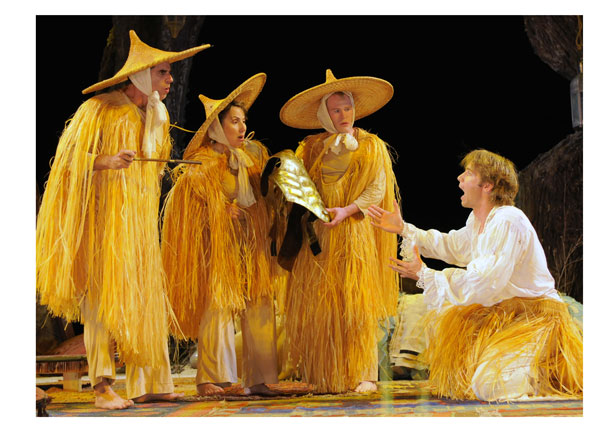
Thursday, April 22, 2010

2010 Season Artist Profile: Daniel Ostling

In the months leading up to our 2010 Main Stage season, we’ll be profiling the creative minds behind the season’s productions—John Steinbeck’s The Pastures of Heaven, Mrs. Warren’s Profession, Macbeth, and Much Ado About Nothing—in our e-newsletters. For the fourth and final installment, I spoke with Daniel Ostling, who is creating the dual-purpose set for 2010’s Macbeth and Much Ado About Nothing. What follows is the full transcript of my email interview with Dan. To sign up for our email newsletter, click here.

What's the first piece of theater you ever saw? Alternately (or in addition), what was the first piece you saw that really made you think, "I want to be a part of this"?


Gosh, I don’t really know, maybe a high school production of Mame my older brother was in. That was NOT the thing that made me want to go into theater, though. When I was in high school, we went and saw Godspell and I distinctly remember finding that thrilling—not the theater part of it as much as how exhilarating it was to have live people running around singing, telling a story, telling THAT story in such a completely different way than I had grown up being told that story. It was alive and uncontrolled, almost dangerous rather than the dead, pre-packaged, deadly predictable way it was told over and over. I didn’t think, at that point, that I could ever be part of creating something like that.

I come from a blue-collar family; my brother and I were the first generation to go to college. I thought I needed to have a job where I made a lot of money (and probably hated). At that point, I was planning on going to school to study business, which is what my brother was studying. The idea of being an artist, coming out, or becoming political active all seemed mythological—not things real people did.

The turning point to me was at the end of my sophomore year in college. While studying business, I took a general education course, astronomy, that I had heard had a cool professor; this was in 1983, in the middle of the Reagan years. That professor, who was from the Netherlands, sort of blew my mind open. It was more of a political science or philosophy course than a science course. He really encouraged the students to think for themselves and asked us what we wanted to do with our lives. I began going to his office and talking to him one on one. I don’t know that I remember much about astronomy but, by the end of that quarter, I knew I could not continue studying business. I had no idea what to do; everyone I knew hated their jobs so I asked myself “what brings me joy? “ Two answers came to mind: 1, watching films; my father used to take us to great films starting when we were little kids, matinees, films really way too intense for young kids but I am so grateful he did this. And 2, lighting designs at rock ‘n’ roll concerts.

So I dropped out of the business school and enrolled in some intro to film classes and, in order to take a lighting course in the theater dept, I had to take the intro to theater course. In that class, the first play we read was Cherry Orchard. I remember how shocked I was at the end of the play; I thought I was missing a page or something. It was so ambiguous, so unresolved—it felt so much like life! I am getting choked up thinking about this again. I think that event is the moment I was hooked, the moment I knew I wanted to do this.

So I guess I really have Henk Houvre from the Northern Illinois University Astronomy Department to thank for changing my life—thanks, Henk.
What inspires you right now? Any particular music, current events, people, et cetera?

I find myself more drawn to the art world and to film than to theater for inspiration. A lot of my friends are filmmakers and artists and I love swimming in those worlds.

I am very interested in and influenced by sight specific art/installation art. I love the innate dialogue that takes place between the environment, the installation and the viewer of the work; I find an immediate connection to what I find most interesting about the theater (that being the relation between the audience and the actors and how it unfolds in time and space).

I am also a fairly political person. It is hard for me not to connect the struggles and issues of our time with the work I am doing and the projects I choose to take.

Facebook has become my new electronic soapbox, although I am not sure anyone is listening.

I looked on your website and your recent C.V.—though impressive as all get-out—doesn’t seem to include any outdoor theater work. If that’s the case, can you talk a little about the specific challenges and opportunities, for you, of designing for outdoors?

I’ve designed a couple things for outdoor venues—I did a Shakespeare in the Park at the Delacorte (Central Park) a few years ago and a couple of operas in Stern Grove here in SF as well.

I don’t think there is any real difference in the aesthetic process of designing for exterior spaces. I think my work is in a dialogue with the space it takes place in—I don’t see set design as being about what is on the stage as much as being about finding a way to connect the space (both the stage and the auditorium) to the story being told—to find a way to manifest the ideas and tensions of the play in time and space. I think this is why I like installation art. The entire experience is the work of art, not just what is up onstage. Time and space become essential elements.

So one of the first things I need to do when working on a new project is to see the space live—to walk in it, take it in. This always affects the design. Of course, being outdoors effects how one approaches the work, but so does being in a Baroque theater, or a small, low-ceiled storefront theater.

Technically, there are a lot of issues that need to be paid attention to when working in an outdoor space

- How will materials hold up to moisture and the sun? Will certain materials warp? Will some materials be slick on the actors’ feet if they get wet (from either rain or dew), etc?

- How will the wind affect the scenery? The wind can treat a piece of fabric like a sail and blow it and whatever it is attached to down. It can also be annoying by constantly making delicate objects move. When I worked at the Delacorte in Central Park, we had a central chandelier and we had to glue each crystal onto plastic sheeting, then assemble the pieces together so it did not tinkle all night.

- Often the lighting positions are much more limited than in a traditional theater, so it is helpful to design lighting positions into the set as well.

- You also generally do not have a proscenium arch or central frame to set off the stage. So the designer must figure out how to help focus the audiences’ attention and frame the action in other ways.
The sets for Macbeth and Much Ado About Nothing will be the same basic structure. Can you talk about the elements that will be the same, and, if possible, what those elements say about how these two seemingly very different stories relate to one another?

When Jon (Moscone) contacted me about doing the project he wanted to approach the shows so they were in dialog with each other. This was a conceptual idea more than a practical producorial one. He felt like the plays were different examinations of men returning from war, stepping back into the norms of a civilian society after living in a world with a very different set of norms. They are two ways of looking at this moment—one through the form of tragedy and one through the form of romantic comedy. Jon speaks much more eloquently about this than I do.

Jon and Joel (Sass) came to Chicago to meet and we looked at some early ideas. I was having trouble finding a design that related to both—the ideas felt either too intellectual or, on the flipside, too simple, looking like we were trying to save money, which was not the reason Jon wanted to do this. I felt that the difference between the shows connected them intuitively (Macbeth dense, dark, obscure, disorienting, shutting off the beauty of the landscape/ Much Ado open, light, clear, framing the landscape). But I was not finding a form that contained them.

We were looking at a rough model for Macbeth that we liked when Jon began removing scenic elements and furniture till just the inner structure remained—it was a great moment and I think we all instantly saw what the answer was. I refined the model a couple times in the next 24 hours and we pretty much saw the ideas come to light.

The set will consist of a simple, planked wooden deck for both productions. The shape and the color/value will be altered between the two. Rising out of this deck will be a pipe structure that will remain for both shows. In Macbeth, it will be raw and corroded, in Much Ado it will be gleaming gold.

For Macbeth, the scaffold will serve as a skeleton on which salvaged architectural element (doors, chandeliers, walk-in freezer rubber strips, etc), and huge slabs of rusty steel and patinaed brass will hang precariously from it. The space will be full of old, salvaged props and furniture that have archetypal, almost dreamlike emotions associated with them (a bed with a antique headboard, a old tub and shower, etc).

In Much Ado, the structure will be exposed with very little added besides a couple of wood windows. In the middle of the scaffold will be a blazing red tree, with patches of tall grass on either side of the scaffold. Only a few pieces of simple, wood furniture will live in the space. The overall feeling is of an airy, open, warm space.

One of my favorite things that you said when you spoke to the Cal Shakes staff back in March was that the Macbeth set would have a kind of “crystalline density.” Could you flesh that idea out a little more for our readers?

When Joel spoke of his early idea he spoke of almost a fever dream, a David Lynch-like world of distortions and confusion, grounded in the concrete reality of mundane objects. We began to realize that the supernatural qualities of the play should be manifest not in fog and hazy visions but in concrete, nonlinear, disorienting ways. When I started to work in the model, I felt like one way to deal with the issue of focus I brought up earlier was to create an open structure that became denser and denser as it moved into the focal point of the space. I felt like the material world almost crystallized moving from the scaffold frame on the outside into a denser and denser claustrophobic center where the characters were stuck. The only way in or out is through this mass of layers and objects—like burrowing rats.

When you were here in March, you also talked about creating, for Much Ado, a “relatively empty space that is warm, but not warmed by objects.” Could you elaborate on that a little more?


I don’t remember saying that … not sure what I meant. To riff off of what I said above, Much Ado is sort of the photographic negative of what we are trying to do with Macbeth in terms of framing and density. In Much Ado, the gleaming scaffold frames the actions with open lines rather than dense planes and objects. There is a diagonal movement across the stage, moving from the hills and trees upstage right across the center of the stage moving gently into the audience down stage left. The space is open, warm, fresh, earnest, and transparent. It is not decorated by dressing or any furniture beside the most essential strokes (two windows to create the courtyard, a table, a set of chairs, some luminaries to create the spectacle of the wedding, etc.
And finally, if you could have designed sets for any play in history, what (and/or where, and/or with who) would it be?

Wow, what a question…

Maybe working on Eugene O’Neill’s Lazarus Laughed, a play from his experimental period that I love. It is an almost impossible play to stage but I have always been drawn to it because of its crazy ambition, its wild form, and its very powerful and subversive story.

…or maybe to have been able to work with Maria Irene Fornes when she was developing her plays for the first time; I think she is an extraordinary writer who has not received the recognition she deserves.

… but if I had to pick one (I have cleverly listed three), I would choose to have worked with Federico Garcia Lorca on his plays before he was assassinated in 1936. To me, Blood Wedding and Yerma are perfect plays that integrate story, spectacle, movement, music, lore, poetry and politics in a seamless tapestry. It would have been such a privilege to work with such an amazing artist; he was a playwright, director, artist, musician, dancer, activist, and poet. It is staggering to think of what he might have created had he not been murdered by the right wing Nationalists.

Subscribe now to get the best seats at the best prices for Macbeth, Much Ado About Nothing, and the rest of our 2010 season. Click http://web.me.com/danielostling to see Dan Ostling’s portfolio, photography, and more.

Wednesday, March 24, 2010

2010 Season Artist Profile: Joel Sass

In the months leading up to our 2010 Main Stage season, we’ll be profiling the creative minds behind the season’s productions—John Steinbeck’s The Pastures of Heaven, Mrs. Warren’s Profession, Macbeth, and Much Ado About Nothing—in our e-newsletters. For the third installment, I spoke featuring Joel Sass, who directed Pericles for us in 2008, and will helm Macbeth at the Bruns this season. What follows is the full transcript of my email interview with Joel. To sign up for our email newsletter, click here.

What projects are you working on right now? What have you done most recently?
Well, I just directed a new production of Noel Coward’s Blithe Spirit for the Jungle Theater in Minneapolis—which was eighth show in a row I’ve directed & designed for that theater. After 16 months of back-to-back activity, I am actually enjoying NOT directing at the moment; this break is giving me time to recharge and focus on pre-production research and planning for my next projects: The Mystery of Irma Vep for the Jungle, The 39 Steps for the Guthrie Theater … and of course this exciting new version of Macbeth for Cal Shakes!

Can you share any early thoughts on Macbeth?
I think Macbeth is one of Shakespeare’s most intense, harrowing journeys – he takes the audience on a dark ride into the most private ecstasies and agonies of Macbeth and Lady Macbeth— the ultimate “power couple”: ambitious, intelligent, and fiercely in love with each other. They are not intrinsically evil, but they nonetheless commit a terrible crime—murder— in order to attain power, wealth and prestige. My current thinking is that the aesthetic for our Cal Shakes Macbeth (both visually and as performed) should be much more contemporary, incorporating strong elements of a gritty ‘reality’ BUT primarily evoking a world and behavior that is more dreamlike, interior, psychological… I’m after a sort of David Lynch-y quality I’d characterize as feverish, ominous, and slightly ritualized… Events in the play should unfold in a space that contains the residue of events that have already occurred OR that will be re-enacted; it is a dream-space that reflects Macbeth’s interior desires, disorder, claustrophobia, anxiety—but the viewer’s conviction about the ‘reality’ of what they witness is periodically subverted: the space and the objects (and even the actors!) within it are mutable and can assume different functions/contexts...I could go on and on, but all this boils down to the notion that we want to create a surprising, psychological thriller/horror show, and not a history pageant/morality play.

For our readers who saw your Pericles here in 2008, what commonalities do you think the two productions will have? (Besides the backdrop of the hills, of course.)
Pericles was a relatively unknown play, and so had the capacity to surprise an audience with a story they didn’t know. Macbeth, conversely, is one of the most well-known plays of Shakespeare—but my hope is that our production will still be packed with surprises and feel fresh, new and immediate. One of the reasons I enjoy working at Cal Shakes is because they are committed to doing “boldly imagined classics”…so, like the Pericles I did in 2008, our new Macbeth will also be performed by only 8 speaking actors, supported by a small four-person ensemble. I am always challenged and invigorated by the task of doing an epic play with a small cast. The exercise invites—actually demands—that the director and the actors commit to making strong imaginative and theatrical choices.

What’s the first piece of theater you ever saw? Alternately (or in addition), what was the first piece you saw that really made you think, “I want to be a part of this”?
The first professional play I saw was A Christmas Carol at the Guthrie Theater when I was in third grade…. I was enthralled by the stagecraft and the story, but it didn’t occur to me I should actually be doing theater until college. At the time, I was a visual arts major specializing in painting and sculpture—and getting a lot of criticism for doing work which was “too narrative.” I’d be told “Stop trying to tell a story! Just make a picture!” And I thought: then what the hell is the point? I figured I could take these visual interests out of the painting studio and into the theater and have a lot more fun….

Who are your all-time favorite directors? Theater and film?
I have a fairly large pantheon of favorite and influential directors…I change theology depending on my mood or what I’m working on at the moment…For today: as a young director, I was very influenced by Dominique Serrand of Theatre de la Jeune Lune, and several of the artists who founded the Minneapolis Children’s Theater. Seeing productions by Joann Akalitis and Peter Brook were hugely inspiring. In film, I am always inspired by Pedro Almodóvar’s gift for crafting narrative, Quentin Tarantino for his comic-book pop-culture panache, and the early films of Jane Campion for their gorgeous mood and composition.

What inspires you right now? Any particular music, current events, people, et cetera?
I’m hypnotized by the phenomenon of Lady Gaga….I don’t know if that is a good or a bad thing for our Macbeth

And finally, if you could have directed any play in history, what (and/or where, and/or with who) would it be?
My sensibilities lean toward the lurid, lusty and bloodthirsty Jacobeans….I’m a big fan of revenge tragedy, so I’d have loved to have directed The White Devil, Women Beware Women, or Titus Andronicus (hint, hint, Jon Moscone!) for a throng of long-ago roaring Londoners who had to walk past a bear-baiting den to reach the theater….

Subscribe now to get the best seats at the best prices for Macbeth and the rest of our 2010 season.

Wednesday, February 17, 2010

2010 Season Artist Profile: Meg Neville

In the months leading up to our 2010 Main Stage season, we’ll be profiling the creative minds behind the season’s productions—John Steinbeck’s The Pastures of Heaven, Mrs. Warren’s Profession, Macbeth, and Much Ado About Nothing—in our e-newsletters. For the second installment, I spoke to Associate Artist Meg Neville, who designed costumes for our productions of Happy Days, An Ideal Husband, and King Lear, among others, and who will costume the first two Cal Shakes plays of 2010, John Steinbeck’s The Pastures of Heaven and Mrs. Warren’s Profession. What follows is the full transcript of my email interview with Meg. To sign up for our email newsletter, click here.

What’s the first piece of clothing you designed and/or made? (This includes clothes for dolls and pets, of course.)
Aside from designing on paper countless academy awards gowns as a child, my first actualized design was for my eighth-grade graduation from St. Paul's Grade School in Scranton, PA. It involved two kinds of white lace and a bright pink lining. I haven't worn lace since.

If you could have designed costumes for any play in history, what do you wish it could have been?
I would like to have designed anything in Paris where riots followed an opening production (including Mrs. Warren's Profession), and Auntie Mame and The Women remain on my list of productions I am waiting to design for Cal Shakes.

Who are your favorite costumers? Fashion designers?
My favorite costume designer in film is, hands down, Sandy Powell (Wings of the Dove, Orlando, Shakespeare in Love), Arianne Phillips ' work in A Single Man (designing for Tom Ford takes talent and courage and she is supposed to be a very nice person); I love the costume work in the films of the Coen Brothers, Wes Anderson, David Lynch, Sofia Coppola, Spike Jonze. In theater, my teacher at YSD, Jane Greenwood, remains a great inspiration for her knowledge of period clothing, her skill with actors, her longevity, her being a mom, and her English accent.

What inspires you right now? Any particular music, current events, people, et cetera?
Inspiring these days? I love looking at The Sartorialist online and all the street photos that are everywhere. It is fun to see how people under 30, which I no longer am, interpret the past. My kids have a way with color and pattern. I saw Fela! in NYC and was blown away by the production, and have been listening to the music every day. In case Prince reads this, I should mention that he remains my number one person-to -please in all things aesthetic. You don't have to love him like I do, but you have to admire the totality of his vision, his talent, and his Purpleness.

Can you share any early thoughts on the costuming for Pastures of Heaven and/or Mrs. Warren’s Profession?
In our first design meeting we talked about 'poetic simplicity'—I think the costumes should feel very real and worn-in, and there will be a simplicity to them since each actor will play five or six characters. Character changes will happen with one element—a hat, a coat, et cetera— over a base costume. I can't say a lot about Mrs. Warren's Profession, except that Mrs. Warren will outglam the English countryside.

Subscribe now to get the best seats at the best prices for John Steinbeck’s The Pastures of Heaven, Mrs. Warren’s Profession, and the rest of our 2010 season.

Tuesday, February 9, 2010

The King and She

We are so happy to announce that The King and I, a meditation on Australian life through the lens of King Lear, by Philippa Kelly—Cal Shakes’ beloved Resident Dramaturg, Grove Talk moderator, and all-around saucy Aussie*—will be published in late 2010. It will be the first of four books in Continuum Press’ “Shakespeare Now!” series, to be distributed in hardcover, paperback, and e-book all over the world at the end of 2010. While this is far from Dr. Kelly’s first published work—the Shakespeare scholar has published widely on Lear and the subject of individuality in 16th- and 17th-century England, among other topics—but it’s exciting nonetheless, as Continuum is exactly the press she had in mind when crafting The King and I.

Mazel tov, Philippa!

*Not to mention occasional contributor to this blog!

Photo by Jay Yamada.

Thursday, January 14, 2010

2010 Season Artist Profile: Octavio Solis

In the months leading up to our 2010 Main Stage season, we’ll be profiling the creative minds behind the season’s productions—John Steinbeck’s The Pastures of Heaven, Mrs. Warren’s Profession, Macbeth, and Much Ado About Nothing—in our e-newsletters. For the inaugural installment, we are introducing newsletter subscribers to playwright Octavio Solis, a Cal Shakes Associate Artist and occasional contributor to this blog. Since 2007, Octavio has been working with us and Word for Word Performing Arts Company to adapt John Steinbeck’s The Pastures of Heaven, the first new play to debut at Cal Shakes in 25 years. What follows is the full transcript of my email interview with Octavio. To sign up for our email newsletter, click here.

Do you remember your very first piece of creative writing, or perhaps the piece that alerted you to the possibilities of the form?
Yes, a pair of poems I wrote in class when I was in the fifth grade. One was a tribute for my mother. The other was a poem called "Ode to a Prairie Dog" or something like that. I lived in Texas and we had these critters everywhere. I was very moved by a ballad I had read in class that practically sang to me: “The Highwayman” by Alfred Noyes. It really made me want to be a poet. Then I discovered Edgar Allan Poe and I consumed everything he ever wrote. All his fiction, all his poetry, everything. I loved him.

Is there a work (literary, musical, or any other form) that would be your dream adaptation project?
I would love to attempt sometime an adaptation of the life of Eva Hesse. She was a beautiful German-born American artist who was one of the biggest influences on Abstract Expressionism. She led a troubled life, surrounded with tragedy and death, from the Nazis to the brain tumor, which eventually took her life. I think her life is compelling enough to warrant a play or film.

What inspires you right now? Any particular music, current events, people, et cetera?
Music is a chief inspiration. I listen to jazz from every epoch, particularly the bebop era, and the jazz-flavored world music coming from the ECM label: Anouar Brahem and Arve Henrikson and the Tomasz Stanko Quartet. Really dark moody stuff. The music takes me to other worlds.

If you could have written any play in history, what do you wish it could have been?
A Streetcar Named Desire. Maybe Our Town.

Who are your favorite writers (theatrical and nontheatrical, living or deceased)?
That changes from year to year and mood to mood. Right now I like the fiction of Roberto Bolaño and the poetry of Mark Strand. I am enamored of the works of Mary Oliver too. And Thomas Hardy. His poetry is as rich in story and nuance as his novels.

You’ve been so very busy these last few years. Do you have any plans to slow down in the next months or years? Or are you just building up momentum to keep going at a similar pace?
I have slowed down. My body has buckled under me and imposed a period of rest. So I am laying low at the moment. I like it. I have been working at a pace that was killing me, and now I don't think I want to do that anymore.

Subscribe now to get the best seats at the best prices for John Steinbeck’s The Pastures of Heaven, and the rest of our 2010 season. Photo by Anne Hamersky.

New Works/New Communities play goes to Edinburgh Fringe!

This weekend, Oaklanders will get another chance to see Hamlet: Blood in the Brain as Oakland Technical High School's award-winning drama department presents the play for three nights. Naomi Iizuka's reimagining of the Shakespeare tragedy transports the scandalous classic to the drug-ravaged streets of mid-1980s Oakland; as American High School Theatre Festival winners, Oakland Tech will tour the production around the Bay Area this spring—including a Feb 24 performance at Stanford and an excerpt performance at Oakland's popular street festival. Art Murmur, on March 5—before traveling all the way to Scotland to present Blood in the Brain at the Edinburgh Fringe Festival!

Back in 2003, Cal Shakes partnered with renowned playwright Iizuka and San Francisco's Campo Santo—the resident theater company at Intersection for the Arts—to launch this first New Works/New Communities project. The play was developed over the course of three years of grassroots community engagement that included community conversations and public readings, and culminated in a sold-out eight-week run at Intersection for the Arts in San Francisco. (Pictured above, Sean San José and Ryan Nicole Peters perform at Intersection; photo by Dave Nowakowski.)

We are so pleased that Oakland Tech is performing this play, and we congratulate them on their AHSTF win. Break a leg!

Click here for more info on the Oakland Tech performances.
Click here for more info on New Works/New Communities, or get regular updates on our new play and community development efforts by signing up for our email list and clicking the box for New Works/New Communities.

Friday, January 8, 2010

Online volunteer registration and serving on a not-for-profit board

There’s some exciting news on several Cal Shakes volunteer service fronts that we’d like to share with you.

First, participants in our general volunteering program—ushers, Inside Scoopers, administrative office helpers, et cetera—will now be able to register and schedule online. In 2009, nearly 500 volunteers recorded more than 4,000 hours, and that’s a lot of us to keep track of. So this year we’ve made it easier by using Shiftboard online scheduling software. Once you’ve registered at shiftboard.com/calshakes you’ll be able to sign up for all of your favorite Cal Shakes opportunities. There are even a few new ones this year, helping out the Artistic staff, actors, and designers. PLEASE NOTE: Everyone—including returning volunteers—must register with Shiftboard in order to receive volunteer information and to schedule a shift. For more information about Cal Shakes volunteer opportunities, contact Jamie Buschbaum at 510.548.3422 x101 or jbuschbaum@calshakes.org.

Secondly, Cal Shakes will be participating in the Board Match event next Tuesday, January 12, 4:30–7:30pm at Moscone Center South in San Francisco. If you’ve ever considered deepening your commitment to Cal Shakes or another not-for-profit by serving on a board, then this free event is for you. The Volunteer Center’s Board Match is a job-fair style event featuring over 100 Bay Area nonprofits—large to small, focusing on everything from the environment to arts toYouth. Serving on a nonprofit board can provide fantastic opportunities for your personal and professional development. You can build new and skills, network and broaden your knowledge of the community and provide essential skills to community nonprofits. This may be the single best opportunity to talk to nonprofit leadership (including Cal Shakes Managing Director Susie Falk) from over 100 Bay Area nonprofits about board membership. Bring copies of your résumé and business cards—board members are the foundation of nonprofit organizations, and we’re looking for a few new recruits! For more information on the event, click theboardmatch.org.