

Hello Cal Shakes blog readers,
I want to share with you an event from the past few days. I very recently heard that one of my ex-students had entered hospice treatment for cancer, and arranged to see him at 9am yesterday. On a mad whim I emailed our own L. Peter Callender the night before, very late and said:
"A student of mine (A.) is in hospice treatment for cancer. He has been a huge fan of yours for years. I'm visiting him at 9 am in North Berkeley tomorrow. Is there the slightest chance you could make it?"
Peter immediately wrote back "yes," and set about clearing his schedule. At 9 the next morning I met him, beautifully appointed and unflappable as ever. We went to A's home together. The look on A's face was something to remember: pure joy at seeing an actor he so admires, and pure happiness at experiencing an undiluted hour of Peter's honesty and wry humor.
I keep thinking of the way our time together closed, with Peter saying: "Well my boy, I am opening a show in September and another in January. I absolutely insist that you be there. You must not fail me. I am setting aside tickets for you."
A. promised to do his best.
Monday, May 24, 2010


Friday, May 21, 2010
Goats at the Bruns! Scads of 'em!
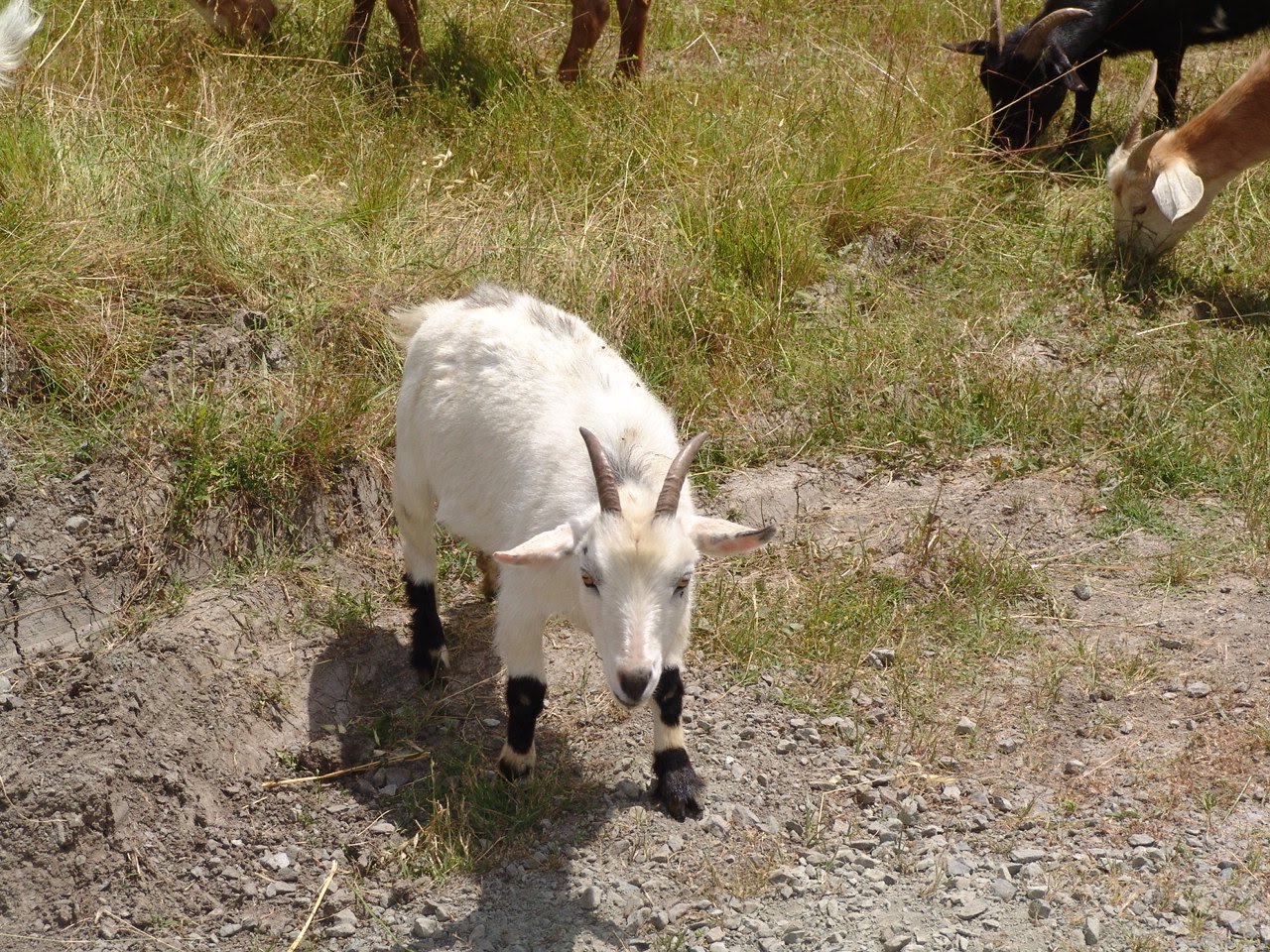
(Donor Relations and Special Events Manager) Beth Sandefur and I just returned from the Bruns, where the great Rachel Lane (our Facilities Manager) has engaged fire goats to trim the grass. Today they were working on the parking lot. The company of goats will be in residence at the Bruns through the weekend, and will emerge from the workshop with a finished piece: a freshly mown outdoor amphitheater.


Monday, May 17, 2010
Actorly thoughts on The Pastures of Heaven
Amy Kossow, Word for Word Performing Arts charter member, has been involved with the development of John Steinbeck's The Pastures of Heaven since the beginning. Now, as an actor in the forthcoming world-premiere production, she blogs from inside the rehearsal room.
 I am playing such an interesting variety of characters in this show: a ghost, a psychotic child, an old biddy, and what I called The Mean Teacher. But Miss Martin has been speaking to me…. Her story is interesting because I am the mother of a child with autism in real life. I think she feels the way a lot of my child’s teachers have felt, that he won’t learn a thing, and then feels shocked by how special a child can be. She hangs her hopes on him and then is unprepared for his rages. She wants to teach him a lesson and has him beaten. Well, she expects that he will learn to behave from the painful punishment, but then he just smiles and that convinces her that he cannot learn. And that she cannot teach. And she resigns. She leaves this Eden. All that in one and half pages of the play! Her whole life captured in a sweep of action.
Charlie Robinson and Rod Gnapp were saying that acting in this play is like film acting—it’s quick. You’ve got to start at a really revved up place and go up from there. There isn’t a slow burn to be had. It’s like the camera is capturing the moment just before each character’s life-changing experience, so the arc we actors like to explore and develop happens lickety-split: you’re-here-now-you’re there. So move it! Now it’s the next guy’s turn! It feels like a kaleidoscope from the inside—we shift and shift and shift, and Moscone, Solis, and Steinbeck make beautiful things happen. In a Forrest Gump-ish sense, this play is like a box of chocolates—we characters may be smooth, or nutty, or sweet, or rotten, or plain or fancy—and the audience gets to eat the whole box.
 I am playing such an interesting variety of characters in this show: a ghost, a psychotic child, an old biddy, and what I called The Mean Teacher. But Miss Martin has been speaking to me…. Her story is interesting because I am the mother of a child with autism in real life. I think she feels the way a lot of my child’s teachers have felt, that he won’t learn a thing, and then feels shocked by how special a child can be. She hangs her hopes on him and then is unprepared for his rages. She wants to teach him a lesson and has him beaten. Well, she expects that he will learn to behave from the painful punishment, but then he just smiles and that convinces her that he cannot learn. And that she cannot teach. And she resigns. She leaves this Eden. All that in one and half pages of the play! Her whole life captured in a sweep of action.
Charlie Robinson and Rod Gnapp were saying that acting in this play is like film acting—it’s quick. You’ve got to start at a really revved up place and go up from there. There isn’t a slow burn to be had. It’s like the camera is capturing the moment just before each character’s life-changing experience, so the arc we actors like to explore and develop happens lickety-split: you’re-here-now-you’re there. So move it! Now it’s the next guy’s turn! It feels like a kaleidoscope from the inside—we shift and shift and shift, and Moscone, Solis, and Steinbeck make beautiful things happen. In a Forrest Gump-ish sense, this play is like a box of chocolates—we characters may be smooth, or nutty, or sweet, or rotten, or plain or fancy—and the audience gets to eat the whole box.
Friday, May 14, 2010
Proceeding neck or nothing
Amy Kossow, Word for Word Performing Arts charter member, has been involved with the development of John Steinbeck's The Pastures of Heaven since the beginning. Now, as an actor in the forthcoming world-premiere production, she blogs from inside the rehearsal room.
Week One:
Day One was a revelation, in many ways. First and foremost was the huge community presence. I expected a table session with cast and director and was blown away by the participation of the extended family of Cal Shakes: tech staff, box office, admin, teaching staff, creative team members, board members, former board members, avid supporters, actors, writer, dramaturg, music, such awesome support and a wonderful reminder of the community nature of theater. Day One was also a revelation for the first hearing of the script. I have been dreaming about this moment for two years, imagining the book opening and the characters standing up and walking about. Octavio Solis has magically seduced the play from the book, and we can now release the book from the process and live in the Pastures of Heaven.
Week Two:
Rehearsals continue apace. The three-story set set showed up on Day Two and blocking commenced immediately. We are proceeding neck or nothing, have choreographed the best part of Act One and now have tackled Act Two. Today is the story of Junius Maltby. There is a goat. Dan Hiatt, JoAnne Winter, and Charlie Robinson are dipping their feet into the water discussing horse-happiness while a chorus of old biddies (me and Richard [Thieriot] and Andy [Murray] and Catherine [Castellanos]) peck and squawk at them. Costume pieces are beginning to show up, which inform our choices immediately. Jon is miraculouly inventive. There is a moment with sheaves of wheat. Honestly, so gorgeous. And the sheer fun of it all as we add a hat and instantly become a new character: a neighbor, a hen, a child, a baby, a farmer, a teacher, a ghost... all accomplished simply. Agghh! There are donuts! Mad stampede!
Week One:
Day One was a revelation, in many ways. First and foremost was the huge community presence. I expected a table session with cast and director and was blown away by the participation of the extended family of Cal Shakes: tech staff, box office, admin, teaching staff, creative team members, board members, former board members, avid supporters, actors, writer, dramaturg, music, such awesome support and a wonderful reminder of the community nature of theater. Day One was also a revelation for the first hearing of the script. I have been dreaming about this moment for two years, imagining the book opening and the characters standing up and walking about. Octavio Solis has magically seduced the play from the book, and we can now release the book from the process and live in the Pastures of Heaven.
Week Two:
Rehearsals continue apace. The three-story set set showed up on Day Two and blocking commenced immediately. We are proceeding neck or nothing, have choreographed the best part of Act One and now have tackled Act Two. Today is the story of Junius Maltby. There is a goat. Dan Hiatt, JoAnne Winter, and Charlie Robinson are dipping their feet into the water discussing horse-happiness while a chorus of old biddies (me and Richard [Thieriot] and Andy [Murray] and Catherine [Castellanos]) peck and squawk at them. Costume pieces are beginning to show up, which inform our choices immediately. Jon is miraculouly inventive. There is a moment with sheaves of wheat. Honestly, so gorgeous. And the sheer fun of it all as we add a hat and instantly become a new character: a neighbor, a hen, a child, a baby, a farmer, a teacher, a ghost... all accomplished simply. Agghh! There are donuts! Mad stampede!
Monday, May 10, 2010
Visiting the Real Pastures of Heaven.
The following blog was written by Trish Tillman, Cal Shakes' director of Artistic Learning.
Last weekend several of us from Cal Shakes and Word for Word Performing Arts Company went to Salinas to hold some events in anticipation of our upcoming world premiere, John Steinbeck’s The Pastures of Heaven. In a moment of free time, JoAnne Winter and Stephanie Hunt of Word for Word and I stole a chance to drive down a road named Corral de Tierra, through the landscape where Steinbeck set his novel. (Pictured below as photographed by playwright Octavio Solis.)
It’s only about 15 minutes outside of the town of Salinas, away from the flat, linear, farm fields, where the land starts to roll and dip and create hundreds of little valleys and large hills. The hills were lush green due to recent rains, the wildflowers were out, there were cows and calves sitting peacefully in the sun and crooked sycamore trees like line drawings dotting the landscape. And (I’m not kidding) the very air seemed perfumed. We rolled down the windows and just breathed in, trying to identify the scent. It became more and more lovely as we slowly drove, gazing around wide-eyed. Phrases started to be uttered such as: “It would be so wonderful to live here.” “Let’s pool our money and buy a big house.” “If I lived here I’d get up very early, and drink coffee on my veranda.” “I’d be able to write all day.” Just like the characters of Pastures, we fell under its spell, and could easily build in our minds a future of comfort and success. The power of this particular part of the world had imposed itself upon us, quietly and thoroughly.

I’ve rarely had this kind of experience, of “being called” simply from a place. I’ve seen some beautiful landscapes and buildings and could imagine myself living there, but rarely has it felt like it could truly be a home. Combined with the promise of being almost within reach—I don’t live that far from this country, I talked with several people who do live in that area—and the whole thing became very seductive.
But there is always rationalization, and reality. I know the housing prices in those sweet valleys are still inflated, and that the kind of work I want and need to do in the arts might not be readily available there, and I would miss my community of friends and family in the Bay Area. I also remember the slightly-more-than-one-would-expect number of "For Sale" signs on houses that we passed on our drive.
So the dream continues. Still available, folks, the American dream embodied in the California landscape, from the time when Europeans set foot on the eastern shores and started wondering, "What’s out there? I bet it’s something good. Maybe."
Last weekend several of us from Cal Shakes and Word for Word Performing Arts Company went to Salinas to hold some events in anticipation of our upcoming world premiere, John Steinbeck’s The Pastures of Heaven. In a moment of free time, JoAnne Winter and Stephanie Hunt of Word for Word and I stole a chance to drive down a road named Corral de Tierra, through the landscape where Steinbeck set his novel. (Pictured below as photographed by playwright Octavio Solis.)
It’s only about 15 minutes outside of the town of Salinas, away from the flat, linear, farm fields, where the land starts to roll and dip and create hundreds of little valleys and large hills. The hills were lush green due to recent rains, the wildflowers were out, there were cows and calves sitting peacefully in the sun and crooked sycamore trees like line drawings dotting the landscape. And (I’m not kidding) the very air seemed perfumed. We rolled down the windows and just breathed in, trying to identify the scent. It became more and more lovely as we slowly drove, gazing around wide-eyed. Phrases started to be uttered such as: “It would be so wonderful to live here.” “Let’s pool our money and buy a big house.” “If I lived here I’d get up very early, and drink coffee on my veranda.” “I’d be able to write all day.” Just like the characters of Pastures, we fell under its spell, and could easily build in our minds a future of comfort and success. The power of this particular part of the world had imposed itself upon us, quietly and thoroughly.

I’ve rarely had this kind of experience, of “being called” simply from a place. I’ve seen some beautiful landscapes and buildings and could imagine myself living there, but rarely has it felt like it could truly be a home. Combined with the promise of being almost within reach—I don’t live that far from this country, I talked with several people who do live in that area—and the whole thing became very seductive.
But there is always rationalization, and reality. I know the housing prices in those sweet valleys are still inflated, and that the kind of work I want and need to do in the arts might not be readily available there, and I would miss my community of friends and family in the Bay Area. I also remember the slightly-more-than-one-would-expect number of "For Sale" signs on houses that we passed on our drive.
So the dream continues. Still available, folks, the American dream embodied in the California landscape, from the time when Europeans set foot on the eastern shores and started wondering, "What’s out there? I bet it’s something good. Maybe."
Thursday, April 29, 2010
Oakland Tech Blogs!
In August, Jessa Berkner's Oakland Technical High School advanced drama students will travel to the Edinburgh Fringe Festival. As American High School Theatre Winners, they will perform Naomi Iizuka's Hamlet: Blood in the Brain, which was the first development project of Cal Shakes' New Works/New Communities program. (For more information, visit our news and NW/NC pages.)
 Currently, Berkner's students are working with Cal Shakes on a modernized Twelfth Night the cast is pictured at right, photographed by Berkner). What follows is what we hope will be the first of several blogs by Naomi Zingman-Daniels and the other OakTechRep students. This blog was written last week, when Twelfth Night was still in performance.
Everyone is rushing around; a girl in a red robe is holding up a beard to her face; another girl is putting yellow fishnets on. This is just another normal scene backstage at OakTechRep, Oakland Tech's advanced drama program. We're in the production week of Shakespeare's Twelfth Night, and every member of the cast and crew is making last-minute preparations, running over lines, and discussing blocking. It's the normal pre-show craziness here.
The 2009-2010 school year is our Shakespeare year here at Oakland Tech. We started out the year with Naomi Iizuka's modern adaptation of Hamlet, entitled Hamlet: Blood in the Brain. Set in 1989 Oakland, it was a really great way to start off. We all got completely into it—Shakespeare's stories are absolutely timeless, and can be set, if you think about it enough, anywhere. And it wasn't just an interesting play for us to do. It hit close to home. Oakland is where we live, where we work, where we go to school. A lot of the problems in both Shakespeare's and Iizuka's versions of Hamlet exist in our community today, and it made it a lot more real for us and a lot easier to get into the script, especially for the actors who hadn't previously studied much Shakespeare.
We're taking Hamlet: Blood in the Brain to the Edinburgh Fringe Festival this summer, and even though all the fundraising and preparation is driving everyone involved a little crazy, we're all really excited for it. It's been a lot of work. We started the show with 16 cast members. In Scotland, we're going to have only nine, so we have to reblock and reassign lines. We've also been raising all the money for it, so that's been crazy, too.
Since we're a repertory theater, we have multiple shows going on at once. We're taking a break from Hamlet with Twelfth Night, and going back in time to 1920s New Orleans and the classic text. We had our first preview last night, and it was amazing. Our Orsino came in just the weekend before, so we've had to cram a lot of rehearsing into very little time. Scenes had to be newly figured out, relationships onstage reworked, and of course, lines to be learned. It's been stressful, of course, and there was the usual arguing over cues and lines and who goes on when backstage before, during, and after the show. But it was a lot of fun. The only real sad thing for me is that there's only going to be two more nights of it.
 Currently, Berkner's students are working with Cal Shakes on a modernized Twelfth Night the cast is pictured at right, photographed by Berkner). What follows is what we hope will be the first of several blogs by Naomi Zingman-Daniels and the other OakTechRep students. This blog was written last week, when Twelfth Night was still in performance.
Everyone is rushing around; a girl in a red robe is holding up a beard to her face; another girl is putting yellow fishnets on. This is just another normal scene backstage at OakTechRep, Oakland Tech's advanced drama program. We're in the production week of Shakespeare's Twelfth Night, and every member of the cast and crew is making last-minute preparations, running over lines, and discussing blocking. It's the normal pre-show craziness here.
The 2009-2010 school year is our Shakespeare year here at Oakland Tech. We started out the year with Naomi Iizuka's modern adaptation of Hamlet, entitled Hamlet: Blood in the Brain. Set in 1989 Oakland, it was a really great way to start off. We all got completely into it—Shakespeare's stories are absolutely timeless, and can be set, if you think about it enough, anywhere. And it wasn't just an interesting play for us to do. It hit close to home. Oakland is where we live, where we work, where we go to school. A lot of the problems in both Shakespeare's and Iizuka's versions of Hamlet exist in our community today, and it made it a lot more real for us and a lot easier to get into the script, especially for the actors who hadn't previously studied much Shakespeare.
We're taking Hamlet: Blood in the Brain to the Edinburgh Fringe Festival this summer, and even though all the fundraising and preparation is driving everyone involved a little crazy, we're all really excited for it. It's been a lot of work. We started the show with 16 cast members. In Scotland, we're going to have only nine, so we have to reblock and reassign lines. We've also been raising all the money for it, so that's been crazy, too.
Since we're a repertory theater, we have multiple shows going on at once. We're taking a break from Hamlet with Twelfth Night, and going back in time to 1920s New Orleans and the classic text. We had our first preview last night, and it was amazing. Our Orsino came in just the weekend before, so we've had to cram a lot of rehearsing into very little time. Scenes had to be newly figured out, relationships onstage reworked, and of course, lines to be learned. It's been stressful, of course, and there was the usual arguing over cues and lines and who goes on when backstage before, during, and after the show. But it was a lot of fun. The only real sad thing for me is that there's only going to be two more nights of it.
Thursday, April 22, 2010
This Week in Artistic Learning
 It's been another very busy week for Cal Shakes' educational programs, which bring arts education to a variety of school communities all year long.
· We held programs in seven schools (three which were underserved) and one library
· We served a total of 652 students through our current residency (433 kids), after-school (19 kids) and Shakespeare workshop (200 kids) programs
· We employed nine talented teaching artists
In addition, Jennifer Antonnaci’s Twelfth Night Residency students at Oakland Tech performed their original script “preview” (in the style of our Student Discovery Matinee moderator Clive Worsley's highly entertaining pre-performance synopsis) for an additional 14 English classrooms, reaching an audience of at least 350 students.
Sooooo, I would say Artistic Learning engaged, either directly or indirectly, at least 1002 students in the East Bay this week.
Pictured above: Artistic Learning Programs Manager Emily Morrison
at the 2009 Summer Shakespeare Conservatory.
at the 2009 Summer Shakespeare Conservatory.
Subscribe to:
Posts (Atom)


 Posts
Posts


