Monday, November 8, 2010

The last of the Carlin-Campbell blogs: Jumping away from conclusion

Last week, Cal Shakes Associate Artist Ron Campbellwho has spent the last few years appearing as The King of the Clowns in Cirque du Soleil's Koozagave a workshop on in our rehearsal hall as the culmination of his Fox Fellowship. The workshop covered mask, clowning, and other physical theater techniques, and was offered to Cal Shakes staff, teaching artists, and other members of our theater community. Nancy Carlin, a fellow Associate Artist, was one of Ron's students, and has been blogging about the class. These are her last two entries; you can read the previous two here and here.

Sunday: Jump away from conclusion.

We did Buffoon Circles. Starting in neutral, you walk in a circle. You don’t

think, plan, contrive, just walk in a circle. Begin t

o notice something—a heavy foot, an imbalanced shoulder, a lopey gait, whatever—and as you continue around in this circle you let this gesture or attribute grow to its fullest, grotesque-est, extremest place. Voilà: your “buffoon” character. Wind them back halfway or more, and you could use this characteristic more “naturalistically”. At its most wound up, you’ve got a full-on extreme character. We then did two buffoon circles side-by-side. When each participant found their full buffoon, they

were then to see each other, circle each other observing carefully, and gradually take on the other’s characteristics—swapping buffoons. And all the while giving the audience their “arêtes”. Quite wonderful!

We then played on an emotional jungle gym. We imagined the floor of our playing space was divided into four quadrants: happy, sad, angry, and afraid. As we passed into that geographic area we instantly were in that emotion. The point being to be successive, not progressive. So often we assume in theater that we have to make this gradual logical evolution from one emotion to the other, when in fact, in life, we quickly switch our states of being. Another such exercise involved an actor, this time in a neutral mask, making her way from upstage to downstage, but on either side of the center line were territories belonging to a “devil” and an “angel”. So, as the character weaved in and out on her way down, she successively changed. Sharp!

The third of these spatial, territorial exercises (TWISTER for clowns), using random phrases of text from the newspaper. We imagined the rehearsal room's space divided into three parts, successively, from left to right. Stage left was the “witness” box, or place for comment. In the center was the “speaker”, very clear and neutral. And on stage right was the “gesture”, the silent movement. So the player could go from box to box in any order, repeatedly or not, and simply read the text (without comment or movement) in the center, or display one or the of the attributes on either side. Really fun to see the effects of dividing all this out.

As with everything, economy of movement, business, what have you, is essential. To illustrate this, Ron had a great example: He took a blank piece of paper, put a pinpoint hole in the center, and held it up for us to see. We could all see this tiny speck quite clearly. H

e then took the paper and crumpled it up and held it up for us again. There was no hope in finding the pinprick now. Lost in the chaos.


Monday: Performance

The final night was our “show”. The first hour, we reviewed things and learned some new stuff, too (why not?), and at 8pm, our audience arrived. This was the night the Giants clinched the World Series; needless to say, our audience was small.

Suddenly, we motley bunch of adult-size children were a troupe! We all showed up our black clothes and went through many of the exercises we had learned. The last ten minutes were a free-flowing succession of various exercises wherein we’d jump in or sit out as felt right, and morph from event to event. Instant Twyla, and then some! We failed big, often, had a few moments of transcendence, and had the unique pleasure of being vulnerable to each otherof sharing humor and heart.

Ron offered to buy the first round at the Albatross. I felt really bad not being able to go out with the group, but I needed to get home right away to my teenage daughter and houseguests. Good thing, too, because the very second I walked in the door I was whisked into a room to work with my daughter on her impending audition for the high school production of The Vagina Monologues. (She got the part! When she works on her moans I’ll have to tell her to be sure to put in some arêtes.) (Now she’ll tell me I’m being “inappropriate”.)

Pictured above: Ron Campbell and class; photos by Jay Yamada.

Friday, November 5, 2010

Recess Repertory, or The Ripple Effect

This story was sent to us by Denise Altaffer, mother of Summer Shakespeare Conservatory student—and Macbeth understudy—Will Altaffer.

My 13-year-old son, Will, participated in the five-week camp this past summer for the first time. He had a fantastic experience and would come home daily with enthusiastic stories of his day. This story, however, is not about him, but about his 10-year- old sister, Adrian, who did not attend camp and had had, at that point, no exposure to Shakespeare.

Adrian would look forward to Will’s stories of camp daily and with some regret for not having chosen to attend camp herself. By the time the end of camp rolled around, she insisted on watching every group perform. Soon after camp ended, and as a direct result from his performance at camp, Will was asked to understudy as Fleance in Macbeth. Will watched Macbeth six times as part of his preparation for this, and Adrian insisted on coming along every single time. She was fascinated by the story; the Wyrd Sisters, in particular, grabbed her imagination. By late August she had all of the Wyrd Sisters’ scenes memorized, and would discuss the details of the blocking and imagery at length.

When school started in the fall, she brought Will’s script to class as her “silent reading” book, which aroused the curiosity of her fellow fifth-grade students. By the end of the first week of school, she had gathered a group of six other fifth-graders, arranged to use the library at recess three days a week, and proceeded to direct and act in the cauldron scene. She designed and made, with my help, all six costumes she would need; re-cast several of the roles as kids decided they weren’t willing to give up that much recess; and, by the middle of October, performed their scene for the entire fifth grade!

That’s seven kids, including Adrian, with no prior Shakespeare exposure, choosing to spend a month and a half of their own time—for no particular reason—learning lines from Shakespeare, and 40 kids watching their peers perform Shakespeare, afterward asking for autographs because, “that was so good, someday you will be famous!”

That’s Cal Shakes Artistic Learning reaching 40 kids and their siblings and their friends and their teachers … without even trying!

Pictured: Adrian Altaffer as a Wyrd Sister, Quin Seivold as Macbeth, and the rest of their recess repertory company; image from video shot by Denise Altaffer.

Wednesday, November 3, 2010

Saturday: From the tube to you.

This past week and weekend, Cal Shakes Associate Artist Ron Campbellwho has spent the last few years appearing as The King of the Clowns in Cirque du Soleil's Koozagave a workshop on in our rehearsal hall as the culmination of his Fox Fellowship. The workshop covered mask, clowning, and other physical theater techniques, and was offered to Cal Shakes staff, teaching artists, and other members of our theater community. Nancy Carlin, a fellow Associate Artist, was one of Ron's students, and will be blogging about the class over the next few days.

A clown celebrates his failure.

We were encouraged to “fail big”. When I was a student at A.C.T. I remember Bill Ball telling us just that: Fail big. Making a big choice, even if it’s a big steaming pile of poo, is so much better than making no choice at all.

More games and some beginning work with masks. Four at a time, we went up with grocery bags over our heads. Standing in “neutral” to begin with, Ron would then call out images. “Be a question mark.” “A smile.” “An exclamation point.” “Okay,” he’d say, “that’s a question mark at a 2. Give me one at 10!”

There was a wonderful kind of freedom, having one’s face safely hidden. And so interesting to watch the exercise from the outside. The slightest incline of the bag-head, a strong but economic gesture, told such a big story. To see what the body emanates when you’re smiling, even though we can’t see a face. It confirms the power of image and imagination. If we can only keep our faces more “neutral” (like the bag), don’t “show” what we’re feeling, just strengthen the image, an inner smile or concern can be read so clearly by our audience, and can draw them in with intrigue, not push them away with the phony “masks” of expression we so often contrive.

Then paper plate masks. Flat white ovals with one pinpoint eye-hole. Myopic vision only. We were given simple directions: Enter, see a stone, pick it up, throw it. Or enter, walk to the edge of the pier and wave good-bye to a loved one. We quickly saw how the bold but economic choices worked best. Too much busy extraneous movement quickly dispersed the story. And as with all the exercises, Ron asked us to include an arrêté, the “ponte fixe”. It is the artist's decision where to place it.

The best players are the most relaxed.

Some leading and following exercises. “Flocking”, where the front of the flock, or “bowling pins” leads a mirror type group movement, which quickly falls to whoever becomes the next lead bird or bowling pin, when the focus shifts to another direction. “Instant Twyla Tharp”, as Ron said.

Energy = glow.

We did some improvs using outside/in dichotomies. How much to hide, and what to leak out, reveal. Wise on the outside, an idiot inside. Sarcastic, grateful. Democrat, Republican. Holy, evil.

Energy = What you get out of it. Like Einstein’s theory. We exist in the “tube” that is the equal sign between energy on one side, and whatever is manifested to balance it out on the other. Ok, so it made sense when he said it…….?

From the tube to you.

Photos by Jay Yamada.

Fingerprints and All: Submitting Yourself to the Unpredictable

This past week and weekend, Cal Shakes Associate Artist Ron Campbellwho has spent the last few years appearing as The King of the Clowns in Cirque du Soleil's Koozagave a workshop on in our rehearsal hall as the culmination of his Fox Fellowship. The workshop covered mask, clowning, and other physical theater techniques, and was offered to Cal Shakes staff, teaching artists, and other members of our theater community. Nancy Carlin, a fellow Associate Artist, was one of Ron's students, and will be blogging about the class over the next few days.

Getting ready to head off to the first session of Ron Campbell’s workshop. He’s had such a wild and amazing couple of years going around the world to study masks and clowning with masters in Greece, Japan, and France and such, on his TCG Fox Fellowship, on top of touring with Cirque du Soleil. The guy’s gonna have stories to tell!

…….

Fun tonight! First session always the most awkward, everyone getting comfortable with each other, etc. Hasn’t changed since first day of kindergarten. Nice big group of teaching artists and assorted clowns and Ron-devotees. Too bad the other Associate Artists couldn’t be there. It’s a tough time slot because anyone in a production wouldn’t be able to attend….

Ron is sporting a phenomenal beard that makes him look like some kind of magical billy-goat or elfin impresario. He started by offering us a wonderful W. H. Auden quote to this effect: that the difference between a craftsman and an artist is that a craftsman knows what the finished product will look like. In essence, we, as artists, should submit ourselves to the unpredictable. The two hours were filled with wise words, fun exercises, and show-and-tell. I experienced my first iPad PowerPointor Finger Point (Finger Drag?)as Ron showed us a slide show of masks and things from his travels. Fingerprints and all.

Random Wisdoms:

We carve the world around us.

How you do one thing, is how you do everything, i.e., how you park the car is how you make love.

Allow the mask to shape your body.

Economy of movement. Arrêtés (stops), moments of stillness. Takes.

Movement trumps sound. Arrêtés trump movement.

Get away from being a show-off.

Looking forward to tomorrow.

Pictured above: Ron Campbell and Nancy Carlin in class;
photo by Jay Yamada.

Friday, October 1, 2010

High-fives, kid wrangling, and the usual "ews" and "aws"

Our first student audience for Much Ado had a great time today. The theater gods blessed us with temperate weather, a virtual army of kid-wrangling staff, extra volunteers and house staff, and a full audience. (Which is a trend that will continue, since all of the fall student shows are sold out!)

I sat in the house with a bunch of middle school boys, who just couldn’t get over how much kissing there was, but I think my favorite moment was when Claudio discovers that Hero is alive at the end of the play and gives her the sweetest hug, which elicited a huge “Awwww!” from nearly every girl in the audience. Nick Childress (Claudio) won more points later in the Q&A with the actors afterwards when a student, half seriously, half jokingly, asked if Nick’s girlfriend minded his having to kiss Emily (Kitchens, who plays Hero) in the play. Nick took the question very seriously and said that, yeah, he and his girlfriend had to really talk about it, and she accepts that it’s part of his job, and that “she knows I love her.” Another big “Awwww!” from the girls (and I think some of the adults, too.)

Dogberry (played by Danny Scheie, above) was also a big hitalthough the vocabulary was a little out of their range, his buffoonery and exclamations of “I am an ass” of course got big laughs. But, beautifully, it also seemed to make him quite endearing.

Andy Murray (Benedick) and Domenique Lozano (Beatrice) also involved the audience wonderfully—when Benedick realized he was in love with Beatrice, Andy high-fived a student in the front row. Then Domenique, skulking through the third row to overhear the gossip on stage, hid by sitting in a student’s seat and putting the girl on her lap as a shield. They were very professional and fun and the students felt really part of the action. Every group left in a good mood and talking about the play.

I am really, really proud that we can share our extraordinary theater work with so many students. We do great stuff here at Cal Shakes, but art of such a high level demands to be seen and shared with young people especially. I heard it said today on NPR that youth participation in art is “rehearsing for a better society,” and I know that to be absolutely true.

Photo by Jay Yamada.

Wednesday, September 22, 2010

"Ask Philippa": MUCH ADO edition

Philippa Kelly, Resident Dramaturg for Cal Shakes,shares her thoughts on our 2010 productions.

In Jonathan Moscone's enchanting and stunningly beautiful production of Much Ado About Nothing, we see and feel a musical elasticity of mood (Shakespeare's own version of "notes", or "noting".) There is the merry banter of the opening; the hopefulness of the wooing scene; the hilarity of mistaken identity played out in the dance; and the calamitous consequences of a misanthropic plot against the marriage of two young lovers. After intermission you'll see mayhem released as the play veers dangerously toward tragedy. Yet somehow, as if by magic, the disastrous events are harmonized in the beautiful simplicty of a plea for redemption and the general joy of a double wedding.

Have you seen our production of Much Ado About Nothing yet? Do you have questions or comments about the production's themes, creative choices, or anything else? Please leave them in the comments, and I'll be sure to respond.

Photo by Jay Yamada.

Tuesday, September 14, 2010

Creating MUCH ADO'S onstage flora

For the ultimate show of Cal Shakes' 2010 season, the audience will see even more greenery than usual at the Bruns Amphitheater: To help create the lush atmosphere of Much Ado About Nothing's Messina, director Jonathan Moscone asked Will's Weeders, our all-volunteer-staffed and -funded gardening group, to landscape the stage, as well.

Below, check out some photos of the work in progress, all by Paul S. Doyle.

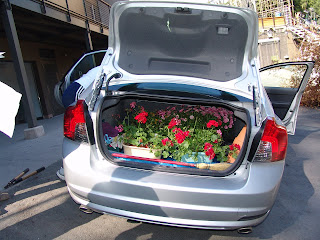
Flowering plants arrive at the Bruns on the morning of September 14:

Muriel Wilson (at left) and Kathy Graeven prune a Mexican lobelia:


From left: Muriel Wilson, Diana Caldwell, Patti James, Dayna Taylor, and Midge Zischke discuss plants to be used onstage during Much Ado, including Mexican lobelia, yellow lantana, geraniums, roses, and marguerites: